
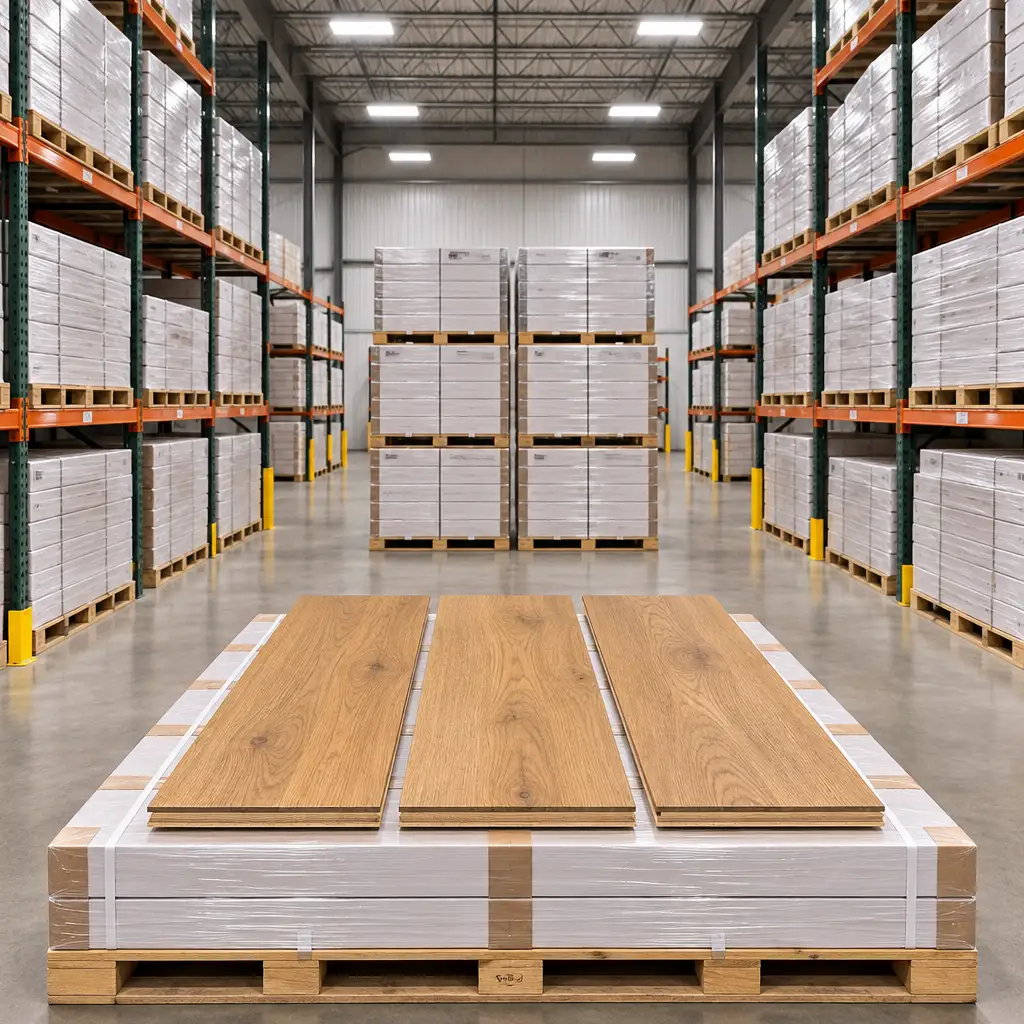
Engineered hardwood is the backbone of most wood flooring programs in the United States. It gives customers real wood on the surface, it handles humidity better than solid wood, and it installs in more places. For a distributor or contractor, buying engineered hardwood wholesale is where margin is made or lost.
This guide covers what you need to know before you buy engineered hardwood flooring by the container: the specifications that set price and performance, how to plan a mixed load, how to compare suppliers, and the checks to run before you place the first order. For product details, see our engineered wood flooring range.
Why engineered hardwood dominates wholesale wood programs
Engineered hardwood uses a real wood wear layer on a cross-layered core. The core resists the expansion and shrinkage that cause gaps and cupping in solid wood. That stability matters for US buyers because it allows installation over concrete slabs, in basements above grade limits set by the maker, over radiant heat where approved, and in humid southern states.
For distributors it means fewer claims and a product that fits more jobs. For contractors it means floating, glue down or nail down installation on the same product family. Read solid wood vs engineered wood for the full comparison.
The specifications that set the wholesale price
| Specification | Common options | Effect on price and performance |
|---|---|---|
| Wear layer | Thin veneer to thick sawn layer | Thicker layers cost more and allow more refinishing |
| Total thickness | Thinner click to thicker glue down boards | Thicker boards feel more solid underfoot |
| Core | Multi-ply plywood, three-layer, HDF | Plywood cores are stable and widely accepted in the US |
| Species | Oak, teak, walnut, maple and others | White oak is the volume leader, exotic species cost more |
| Grade | Select, natural, character, rustic | Cleaner grades cost more per square foot |
| Width and length | Standard to wide and long planks | Wide long planks need bigger veneers and cost more |
| Finish | UV lacquer, UV oil, hardwax oil | Brushed, smoked or hand-scraped add cost |
| Profile | Tongue and groove or click | Click suits DIY retail and fast installs |
When you compare two wholesale offers, put them in a table like this. Most price differences come from the wear layer, the core and the grade. Our guide to the flooring technical data sheet shows which numbers to ask for.
Planning a container of engineered hardwood
Wholesale engineered hardwood is usually shipped in full containers. A well planned load keeps freight per square foot low and avoids dead stock.
- Start with your best sellers. Build most of the container around two or three proven colors and sizes.
- Add accessories in the same load. Matching stair nosing, reducers and quarter round sell with the floor and are expensive to ship separately.
- Balance weight and volume. Engineered boards are heavy, so containers can reach weight limits before they are full. Ask your supplier for the loaded quantity per container for each item.
- Keep a lot record. Note the production lot of each color so reorders can be matched to retained samples.
How to compare engineered hardwood suppliers
| Check | What good looks like |
|---|---|
| Written specifications | A technical data sheet per product, matching the sample |
| Production samples | Samples from current production, not a showroom piece |
| Quality control | Pre-shipment inspection of dimensions, moisture, finish and packing |
| Moisture content | Stated range at shipment, suitable for your region |
| Documentation | Test reports, emission compliance and origin stated clearly |
| Consistency | Retained lot samples and a reorder matching process |
| Communication | A team that answers technical questions in your time zone |
For the full checklist, read how to evaluate a flooring supplier.
Compliance for engineered hardwood sold in the US
Engineered hardwood often contains plywood or HDF, which counts as composite wood under US formaldehyde rules. Buyers should ask for evidence of compliance with EPA TSCA Title VI, which is aligned with the California CARB Phase II limits. Ask for the certificate and the name of the third-party certifier. Our article on formaldehyde-free flooring explains the emission standards.
Country of origin must also be clear on packaging and paperwork. Karlyn Floors engineered hardwood is made in mainland China and inspected by our Taiwan team before loading. Our article on China Plus One sourcing explains how buyers manage single-country supply risk.
Common mistakes when buying engineered hardwood wholesale
- Comparing prices without matching wear layer and core.
- Approving a sample that does not come from the production you will receive.
- Ordering too many colors in the first container.
- Skipping moisture content checks for humid destinations.
- Forgetting accessories and then shipping them by air.
- Not agreeing on grade photos before production.
Engineered hardwood from Karlyn Floors
We supply engineered wood flooring and engineered teak flooring to distributors, retailers and contractors, mainly in the US. Every order is quoted against a written specification and checked before shipment. If you want to sell under your own name, see private label flooring. For trade terms, visit wholesale flooring.
FAQ
What wear layer should wholesale engineered hardwood have?
It depends on the market. Thicker wear layers suit premium residential and commercial work where refinishing matters. Thinner layers suit price-driven programs.
Is engineered hardwood suitable for humid states?
Yes, it is more stable than solid wood. Follow the installation guide and acclimation rules. See our humid climate flooring guide.
Can I mix species and sizes in one container?
Usually yes. Your supplier will confirm the mix and loaded quantities.
How do I keep color consistent between orders?
Approve master samples, keep lot records and ask the supplier to match each reorder to retained samples.
Do you offer samples for wholesale buyers?
Yes. Contact us with the products you are considering.
Request an engineered hardwood quote
Send us your species, sizes, grades and yearly volume. We will reply with samples, technical data sheets and a written quote. Request a quote.