
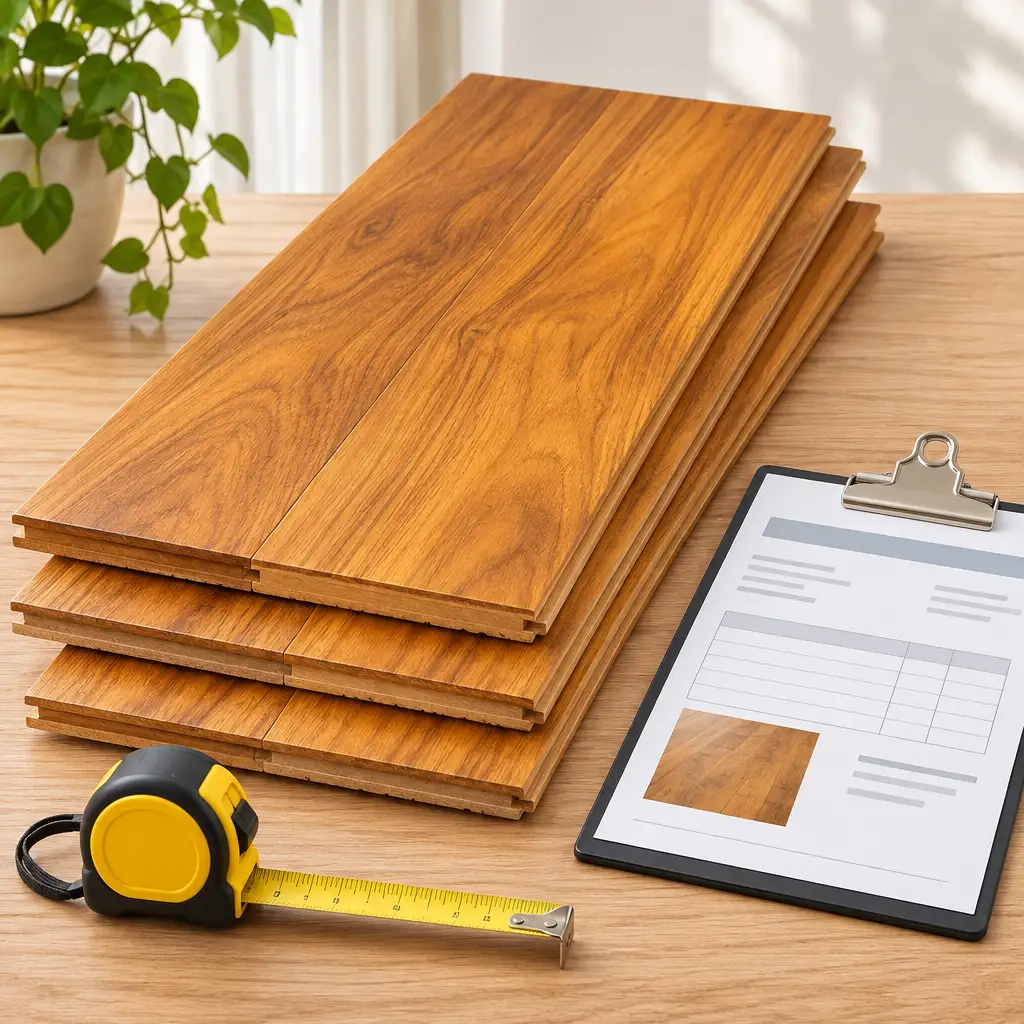
Teak flooring has a reputation as one of the most expensive wood floors you can buy. That reputation is only half right. Two teak floors that look similar in a photo can be quoted at very different prices, and the reasons are rarely explained on a price list.
This guide is written for flooring distributors, retailers, builders and contractors who buy teak in volume. It explains what actually drives the teak flooring price per square foot, how solid and engineered teak compare, and how to read two quotes side by side so you compare the same product. If you are new to the species, start with our teak flooring guide and then come back here for the cost side.
How much does teak flooring cost?
There is no single teak flooring price because “teak” covers several sources, grades and constructions. As a rough orientation, published US retail listings for prefinished teak flooring material often sit somewhere between the mid single digits and the mid teens in US dollars per square foot, before installation. Premium old-growth or wide-plank solid teak can go well beyond that range, while engineered teak with a thinner veneer usually sits toward the lower end.
Wholesale prices for container quantities are lower than retail listings, but they move with log supply, grade and freight. Treat any number you see online as a starting point only, and always compare offers on the specification sheet rather than the headline price. For a current quote on Karlyn Floors teak flooring, send us your size, grade and volume.
The seven factors that drive teak flooring prices
1. Construction: solid or engineered
Solid teak uses a full board of teak through its whole thickness. Engineered teak uses a teak wear layer bonded to a stable core, often plywood. Because the expensive species makes up only the top layer, engineered teak usually costs less per square foot and is also more stable over underfloor heating and in humid regions.
2. Wear layer thickness
On engineered teak, the thickness of the teak veneer is one of the biggest cost drivers. A thicker wear layer means more teak per plank and more future sanding cycles. When two engineered teak quotes differ a lot, check the wear layer first.
3. Source and growth type
Teak from natural forests, especially older slow-grown stock, is denser, more oily and more stable. Plantation teak grows faster and often shows more color variation and lighter sapwood. Both can make good floors, but natural-growth teak commands a higher price.
4. Grade and color uniformity
Select grades with even golden-brown color and few knots cost more than rustic or character grades. If your project accepts natural variation, a character grade can lower the price without changing the species.
5. Plank width and length
Wide and long planks need larger logs and yield less usable material, so they cost more per square foot. Random-length bundles are usually cheaper than fixed lengths.
6. Finish and surface treatment
UV oil, UV lacquer, hardwax oil, brushing, smoking and hand-scraping all add steps. Unfinished teak is cheaper to buy but costs more to finish on site.
7. Certification and documentation
Legality documentation and chain-of-custody certification add cost upstream. For buyers in regulated markets this cost is not optional. Our flooring certifications guide explains what each document proves.
Solid vs engineered teak: cost and performance compared
| Factor | Solid Teak | Engineered Teak |
|---|---|---|
| Relative material cost | Higher | Lower to medium |
| Teak content per plank | Full thickness | Wear layer only |
| Stability in humidity | Good for a solid wood | Better, thanks to the cross-layered core |
| Underfloor heating | Use with caution | Usually suitable, check the data sheet |
| Refinishing cycles | Many | Depends on wear layer |
| Installation | Nail down or glue down | Glue down, floating or click |
| Best fit | Luxury residential, heritage projects | Apartments, hotels, larger developments |
For a broader comparison of the two constructions, read solid vs engineered wood flooring.
The full installed cost is more than the material price
Contractors know that the plank is only part of the bill. When you budget a teak floor, include these items.
| Cost item | What to check |
|---|---|
| Flooring material | Construction, wear layer, grade, size and finish |
| Waste allowance | Usually higher for wide planks and patterns |
| Subfloor preparation | Leveling, moisture testing, moisture barrier |
| Adhesive or underlay | Depends on installation method |
| Installation labor | Glue down and nail down cost more than floating |
| Trims and accessories | Stair nosing, reducers, skirting |
| Freight and duties | For importers, landed cost per square foot |
| Maintenance | Oil refresh or recoating over the floor’s life |
Because teak lasts for decades, cost per year of service is often lower than for cheaper floors that need replacing. Our flooring lifespan comparison puts numbers to that.
How to compare teak flooring quotes
When two suppliers send prices, line them up against the same specification. A lower price usually means a difference in one of these lines.
- Total thickness and wear layer thickness
- Core material and number of plies on engineered teak
- Grade description with photos of the grade range
- Plank width, length and percentage of short boards
- Finish type and number of coats
- Moisture content at shipment
- Packing per carton and per pallet
- Origin and documentation provided
Ask for a technical data sheet and a physical sample from the same production you will receive. Our guide on how to evaluate a flooring supplier covers the rest of the checklist.
Ways to lower the cost of a teak floor
- Choose engineered teak instead of solid where stability matters more than sanding cycles.
- Accept a character grade for rustic or contemporary interiors.
- Use random lengths instead of fixed long boards.
- Buy prefinished to save on-site finishing labor.
- Consolidate orders into full containers to lower freight per square foot.
- Use teak for feature areas and a more economical floor in back-of-house spaces.
If teak is above budget for part of a project, engineered oak flooring or our ResinCore range can carry a similar warm look at a lower cost.
Why buy teak flooring from Karlyn Floors
Karlyn Floors supplies teak flooring to distributors and project buyers, mainly in the United States. All our flooring is made in mainland China and checked by our Taiwan team before shipment. We quote against a written specification so you can compare our price with other offers on equal terms. See our wholesale flooring page for how trade programs work.
FAQ
Why is teak flooring so expensive?
Teak grows slowly, is in high demand for boats and furniture, and good logs are limited. Its natural oils and stability also make it a premium flooring species.
Is engineered teak cheaper than solid teak?
Usually yes, because only the top layer is teak. The price gap narrows as the wear layer gets thicker.
Is plantation teak flooring good quality?
It can be. Plantation teak is often lighter and more varied in color than natural-growth teak, so check samples and grade photos.
How long does a teak floor last?
A well-maintained solid or thick-veneer engineered teak floor can last for decades and can be sanded and refinished.
Can I get a wholesale teak flooring price list?
Prices depend on specification and volume, so we quote per program. Send us your requirements for a written quote.
Get a teak flooring quote
Tell us the construction, size, grade and quantity you need. We will reply with a written quote and samples. Request a teak flooring quote.