

The EU Deforestation Regulation has been delayed twice, amended once, and debated continuously since it entered into force in June 2023. None of that changes what matters now: for large and medium-sized operators, and for micro and small operators already covered by the EU Timber Regulation, enforcement begins on 30 December 2026. That date is confirmed by Regulation (EU) 2025/2650, and the Commission’s simplification review in May 2026 confirmed that there will be no further postponement for the EUDR flooring supply chain.
For flooring buyers, distributors, and importers who source wood-based products from outside the EU, EUDR flooring compliance is no longer a future planning exercise. It is a current operational requirement with a deadline that arrives on 30 December 2026. For EU buyers sourcing EUDR flooring, if your supply chain documentation is not in order by the time that deadline passes, you risk shipment refusal, fines, and in serious cases market exclusion.
This guide covers what the regulation actually requires, which flooring products are in scope, what due diligence documentation looks like in practice, and the specific steps that non-EU exporters and EU importers need to take before the enforcement date. I have been working through EUDR compliance for our own wood-based range — teak solid wood flooring, engineered wood flooring and HDF-core laminate — for over a year, and the practical questions are considerably more complex than the regulation’s headline requirements suggest.
What EUDR Flooring Compliance Actually Requires
The EU Deforestation Regulation prohibits the placing on the EU market, or the export from the EU, of specific commodities and products that have contributed to deforestation or forest degradation. For the flooring industry, the relevant commodity is wood. Any product that contains wood and is placed on the EU market must be accompanied by a due diligence statement (DDS) confirming that the wood was not sourced from recently deforested land, and that it complies with the laws of the country of harvest.
“Recently deforested” is defined precisely: land that was forest after 31 December 2020 and has since been converted to agricultural or other non-forest use. This cut-off date applies regardless of when the timber was harvested or when the product was manufactured. A product made from timber legally harvested in 2024 from land that was deforested in 2021 is non-compliant under EUDR — even if the harvest itself was legal under the laws of the country of origin.
The Due Diligence Statement: What It Must Contain
Every operator placing a wood-based product on the EU market must submit a due diligence statement through the EU Information System for EUDR before the product enters the market. The DDS must include the following information for each product:
- Product description, HS code, and quantity
- Country of production (where the timber was harvested)
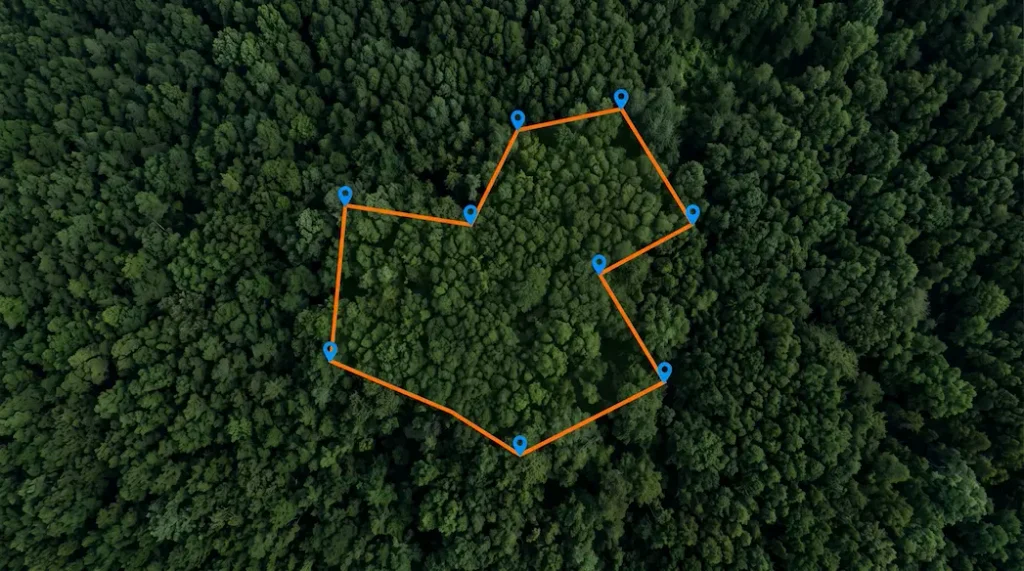
- Geolocation coordinates of all plots of land where the relevant commodity was produced — specifically, the GPS coordinates of the forest plots from which the timber originated
- A statement that due diligence has been carried out and that no or only negligible risk of non-compliance was found
- Name and contact details of the operator submitting the statement
The geolocation requirement is the one that creates the most practical difficulty in flooring supply chains. It requires traceability back to the specific forest plots where the timber was harvested — not just the country of origin, not just the certified forest management unit, but the actual GPS polygon of the harvest area. For flooring products manufactured from timber that passed through multiple processing stages, establishing and documenting this chain of custody is a significant undertaking.
Who Is the Operator Under EUDR Flooring Rules?
Under Regulation (EU) 2025/2650, the primary obligation falls on the “operator” — defined as the person or entity that places the product on the EU market for the first time, or exports it from the EU. In practical terms for the flooring supply chain:
- A non-EU manufacturer selling directly to an EU buyer: the EU buyer is the operator and holds the primary compliance obligation
- An EU distributor importing from a non-EU supplier: the EU distributor is the operator
- A non-EU exporter selling through an EU trading entity: the EU trading entity is the operator
The revised regulation introduced a “downstream operator” category for entities further down the supply chain — retailers, installers, and secondary distributors — who can reference an existing DDS rather than conducting their own full due diligence. This reduces the administrative burden downstream but does not eliminate the obligation: the downstream operator must verify that a valid DDS exists for the product before placing it on the market.
Which EUDR Flooring Products Are In Scope
EUDR flooring scope is determined by the product’s HS code and whether it contains wood as a regulated commodity. The following categories are clearly within scope:
| Flooring Product | HS Code Range | EUDR In Scope? | Notes |
|---|---|---|---|
| Teak Solid Wood Flooring | 4409 / 4418 | Yes | Direct wood commodity — highest scrutiny, geolocation to harvest plot required |
| Engineered Wood Flooring | 4412 / 4418 | Yes | Wood veneer top layer and plywood core both in scope, full chain traceability required |
| Laminate Flooring (HDF core) | 4411 | Yes | HDF core is wood-derived, wood fibre sourcing must be documented |
| SPC Flooring | 3918 | No | Stone-plastic composite, no wood content — outside EUDR scope |
| ResinCore (Recycled Epoxy Resin) | 3918 | No | No wood content — outside EUDR scope |
The practical implication of this scope is significant. For Karlyn Floors, our teak solid wood flooring, engineered wood flooring, laminate flooring and MoistureShield 1000 are within EUDR scope and require due diligence documentation. Our SPC flooring and ResinCore are outside scope entirely, which simplifies their compliance profile considerably for European buyers. The Commission’s 2026 Delegated Act on product scope also clarifies that samples and products used for analysis, examination, and testing fall outside the regulation, which matters for buyers who request samples before placing an order.
EUDR Flooring and Laminate: The Wood Fibre Traceability Challenge
Laminate flooring presents a particular compliance challenge that is worth addressing directly. The HDF core of a laminate plank is manufactured from wood fibre — typically a mix of softwood and hardwood fibres that have been processed, compressed, and bonded with resin. Tracing the wood fibre in an HDF core back to specific forest plots is technically demanding because the fibre typically originates from multiple sources and passes through industrial processing that obscures its geographic origin.
The practical approach that most laminate manufacturers are taking is to obtain FSC or PEFC chain-of-custody certification for their HDF core material, which provides a documented and audited wood fibre sourcing system that can support EUDR due diligence. An FSC-certified laminate product does not automatically satisfy EUDR — the regulation requires deforestation-free evidence, not just sustainable management certification — but FSC certification significantly strengthens the due diligence case and reduces the risk assessment from “standard” toward “negligible.”
Country Risk Classification: What It Means for Your Supply Chain
The EUDR operates a country benchmarking system that classifies countries as high risk, standard risk, or low risk based on their deforestation rates and governance quality. The risk classification of the country where the timber was harvested — not where the product was manufactured — determines the level of due diligence scrutiny required for any EUDR flooring shipment entering the EU.
The Commission’s first country classification, adopted in May 2025, placed only four countries in the high-risk category: Belarus, Myanmar, North Korea, and Russia. About 140 countries are classified as low risk, including all EU member states, China, the United States, Canada, and Japan. The remaining roughly 50, including Brazil, Indonesia, and Malaysia, are standard risk. The tier also sets how often authorities check operators: 1% for low risk, 3% for standard risk, and 9% for high risk. The classification is due for its first review in 2026, so confirm the current list before relying on it.
For flooring manufactured in mainland China, as ours is, this distinction matters: the country of manufacture does not set the risk level. What counts is where the timber in the veneer, core or HDF was harvested, which is why we document harvest origin for each wood-based product rather than relying on the place of manufacture.
Standard Risk Does Not Mean No Due Diligence
A common misconception in the industry is that sourcing from a standard-risk country reduces or eliminates the EUDR due diligence obligation. It does not. Standard risk means that the due diligence process is the baseline — collect the documentation, assess the risk, submit the DDS. High risk means additional scrutiny and a higher evidence threshold. Low risk allows a simplified due diligence process focused on information gathering, but operators must still assess the risk that the product is mixed with material from higher-risk countries. Standard risk requires full compliance, and the geolocation data requirement applies regardless of the country’s risk classification.
For buyers sourcing teak or tropical hardwood from Southeast Asia — Myanmar being a specific case — the country risk classification is a direct commercial consideration. Teak sourced from Myanmar is a high-risk origin under EUDR, and the due diligence burden for that origin is substantially higher than for teak sourced from other origins. Buyers who have been sourcing from Myanmar need to assess whether the compliance infrastructure exists to support continued sourcing, or whether certified plantation teak is the more practical path. Our teak flooring guide covers teak origins and certification in detail.
Geolocation Data for EUDR Flooring: The Practical Reality
The geolocation requirement is the aspect of EUDR that creates the most operational difficulty, and the one where the gap between regulatory intent and supply chain reality is widest. The regulation requires GPS coordinates — either a point or a polygon — for the plots of land where the timber was harvested. For plantation timber from large, organised forestry operations, this data is often available from existing forest management systems. For timber sourced from smallholders, community forests, or fragmented supply chains across multiple countries, obtaining verified geolocation data requires either direct engagement with the harvest source or reliance on intermediary verification systems. Plots of up to four hectares can be located with a single point, plots larger than four hectares require a polygon describing the boundary, and all coordinates must carry at least six decimal places and be submitted as a GeoJSON file.
The Commission provides a free EU Observatory on deforestation and forest degradation, which includes a 2020 global forest cover map, the legal cut-off year, to help operators check harvest plots.
EUDR Compliance Timeline: What Needs to Happen Before 30 December 2026
With enforcement beginning on 30 December 2026, the window for preparation is short. The following table sets out the key steps for both EU importers and non-EU exporters of wood-based flooring products, with realistic timeframes.
| Action | Who Is Responsible | Deadline | Notes |
|---|---|---|---|
| Identify all in-scope products by HS code | EU importer / non-EU exporter | Immediately | Confirm which products contain wood and fall within EUDR commodity scope |
| Request geolocation data from supply chain | EU importer (via non-EU supplier) | Immediately | GPS coordinates for harvest plots, allow time for supplier response and verification |
| Conduct risk assessment for each product origin | EU importer | By mid-December 2026 | Assess deforestation risk using country classification, geolocation data, and certification evidence |
| Register on the EU EUDR Information System | EU importer (operator) | Now | Account registration required before DDS can be submitted |
| Submit Due Diligence Statements | EU importer (operator) | Before 30 December 2026 | One DDS per product shipment, reference number must accompany the goods |
| Prepare documentation package for customs | EU importer / non-EU exporter | Before first post-deadline shipment | DDS reference number, certificate of origin, FSC/PEFC certificates if applicable |
The Information System reopened in June 2026 after technical updates, and the Commission offers training sessions for companies.
How to Actually Submit a Due Diligence Statement
The DDS is submitted through the EU EUDR Information System, an online platform operated by the European Commission. Registration is required before the first submission — operators need an EU Login account linked to their company’s legal entity. Allow several business days for account verification, do not leave this until the week before your first post-deadline shipment.
Each shipment must be covered by a due diligence statement that lists the products and the geolocation of every plot they came from. Once submitted and validated, the system generates a unique DDS reference number that must accompany the shipment through customs. Without that reference number, the goods cannot be cleared. For EUDR flooring shipments, this reference number becomes as essential as the certificate of origin or the commercial invoice.
What Non-EU Exporters Need to Provide
While the primary legal obligation under EUDR falls on the EU operator, non-EU exporters of wood-based EUDR flooring bear a significant practical burden in supplying the documentation that makes compliance possible. An EU importer cannot submit a credible due diligence statement without accurate information from their supplier. In practice, this means non-EU exporters need to prepare and maintain the following:

Documentation Package for EUDR-Compliant Wood Flooring
At minimum, a non-EU exporter of wood-based flooring products destined for the EU market should be able to provide, for each product and shipment:
- Geolocation data for harvest plots: GPS coordinates (point or polygon) for the forest areas from which the timber originated, in a format compatible with the EU EUDR Information System. If the timber passed through intermediary processors, geolocation data from each relevant stage of the supply chain.
- Proof of legal harvest: Documentation confirming that the timber was legally harvested under the laws of the country of origin — logging permits, harvesting licences, or equivalent official documentation.
- Chain of custody documentation: Records linking the harvested timber through each processing stage to the finished flooring product. For certified products, FSC or PEFC chain-of-custody certificates with current validity.
- Deforestation-free declaration: A supplier declaration confirming that the timber did not originate from land deforested or degraded after 31 December 2020.
- Species identification: Scientific name (genus and species) for each timber species used in the product. For teak, this is Tectona grandis. For engineered wood, the species of the veneer layer and the core material must both be identified.
The depth of documentation required is substantially greater than what most wood flooring exporters have been maintaining for EUTR (EU Timber Regulation) compliance. EUTR required operators to exercise due diligence and maintain records, but it did not require geolocation data or the same level of species and origin specificity. Exporters who have been relying on their EUTR compliance systems as a foundation for EUDR compliance will need to augment those systems significantly. Our supplier evaluation checklist shows how to test whether a supplier can actually deliver this package.
The Consequences of EUDR Flooring Non-Compliance
EUDR non-compliance carries penalties that are designed to be proportionate to the economic benefit of the non-compliant activity. Under Article 25 of the regulation, member states are required to impose penalties that are effective, proportionate, and dissuasive. The specific penalties are set at member state level, but the regulation establishes minimum requirements:
- Fines, with the maximum set by each Member State at no less than four percent of the operator’s total annual EU-wide turnover
- Confiscation of the non-compliant products and of the revenue gained from them
- Temporary exclusion of up to twelve months from public procurement and public funding
- Temporary prohibition from placing products on the EU market or exporting them
Enforcement will not look the same everywhere. In November 2026 the European Commission sent letters of formal notice to Bulgaria, Greece, Malta and Poland for failing to designate and notify the competent authorities that enforce the EUDR (source: EUbusiness).
That gap does not move the timetable, because the 30 December 2026 date for large and medium-sized operators, and for micro and small operators dealing in timber products, still stands (source: European Commission, Access2Markets).
In my view, uneven enforcement is a reason to prepare your supplier documentation now rather than a grace period, because your EU buyer still needs due diligence information for every shipment.
Beyond the formal penalties, the commercial consequences of non-compliance may be more immediately damaging. A shipment that cannot be cleared at customs because the EUDR documentation is incomplete or missing creates immediate operational disruption — port storage costs, delayed project timelines, and in worst cases rejected shipments that must be returned or destroyed. In a market where EU buyers are under increasing pressure from their own clients and investors to demonstrate supply chain sustainability, a supplier who cannot produce EUDR-compliant documentation is a liability, not just a compliance risk.
EUDR and FSC: Complementary, Not Interchangeable
The relationship between EUDR flooring compliance and existing forest certification systems — particularly FSC and PEFC — is one of the most frequently misunderstood aspects of the regulation. FSC certification is a market-based voluntary standard that verifies responsible forest management and chain of custody. EUDR is a legal regulatory requirement that mandates deforestation-free sourcing. The two systems address overlapping concerns but are not substitutes for each other. Our flooring certifications guide explains what FSC and other marks prove and what they do not.
FSC certification provides strong evidence for the due diligence assessment — a product with a valid FSC chain-of-custody certificate has been verified by an accredited certification body to have maintained documented custody from a certified forest source to the finished product. This evidence supports a “negligible risk” finding in the EUDR due diligence process. However, FSC certification alone does not fulfil the EUDR obligation because it does not automatically provide the geolocation data that the regulation requires to be submitted in the DDS.
The practical implication is that FSC-certified suppliers are in a significantly better compliance position than uncertified suppliers — the certification infrastructure provides much of the traceability backbone that EUDR requires — but they still need to ensure that geolocation data is extracted from that system and made available for DDS submission.
Frequently Asked Questions About EUDR Flooring Compliance
Does EUDR apply to SPC flooring?
No. SPC (Stone Plastic Composite) flooring does not contain wood and is outside the scope of EUDR. The regulation applies to products that contain wood as a commodity — solid wood flooring, engineered wood flooring, and laminate flooring with wood-based HDF cores are all within scope. SPC flooring, which uses a limestone and PVC composite core with no wood content, is not subject to EUDR requirements. If you are an EU importer sourcing SPC flooring, no due diligence statement is required for EUDR purposes, though other documentation requirements such as CE marking under EN 14041 still apply.
What is the deadline for small and micro enterprises?
It depends on the sector. Micro and small operators that are already covered by the EU Timber Regulation, which includes importers of wood flooring, must comply from 30 December 2026, the same date as large and medium operators. The later date of 30 June 2027 applies only to other micro and small operators outside the timber sector. For most EU flooring importers, the practical planning date is therefore 30 December 2026, whatever their size. Micro and small primary operators can use simplified declarations in the EU Information System, so check the Commission’s FAQ for the conditions that apply to your company.
Can existing FSC certification satisfy EUDR flooring compliance requirements?
FSC certification significantly supports EUDR compliance but does not by itself satisfy all requirements. A valid FSC chain-of-custody certificate provides strong evidence for the due diligence risk assessment and reduces the deforestation risk finding toward negligible. However, the EUDR due diligence statement requires geolocation data — GPS coordinates for harvest plots — that FSC certificates do not automatically include in a format ready for DDS submission. FSC-certified suppliers are in a better starting position than uncertified suppliers, but additional steps are required to extract and format the geolocation data for EU Information System submission.
What happens if my supplier cannot provide geolocation data?
If your supplier cannot provide verified geolocation data for the timber harvest plots, you cannot complete a EUDR due diligence statement that meets the regulation’s requirements. In that situation, you have three options: work with your supplier to obtain the data (which may require them to engage further back in their own supply chain), switch to an alternative supplier who can provide the required documentation, or source products that are outside EUDR scope — such as SPC flooring or ResinCore — where the compliance burden does not apply. Submitting a DDS with incomplete or unverified geolocation data is not an acceptable workaround, it exposes the operator to the same penalties as non-submission.
Does EUDR affect flooring sold in the United States?
No. EUDR applies only to products placed on, or exported from, the EU market. Flooring imported into the United States is governed instead by the Lacey Act, which requires a declaration of species and country of harvest for wood products and prohibits illegally harvested timber. Many of the same documents, particularly species identification and harvest-origin records, support both regimes, so US buyers who also sell into Europe can build one documentation file for both.
Is there still time to achieve compliance before the December 2026 deadline?
For large and medium-sized operators, yes — but the window is narrow. The critical path item is geolocation data from the supply chain, and obtaining, verifying, and formatting that data takes time. Operators who have not yet begun their EUDR preparation should initiate supplier conversations immediately, focus first on their highest-volume and highest-risk product lines, and prioritise products where the supply chain is shortest and most transparent. Products with existing FSC or PEFC chain-of-custody certification are the easiest starting point. For comprehensive support on EUDR compliance documentation for wood-based flooring sourced through Karlyn Floors, contact our team directly — we have been building our EUDR documentation infrastructure for over a year and can provide supplier-level documentation to support your due diligence process.
Where to Go From Here
EUDR flooring compliance is not a one-time documentation exercise. It is an ongoing operational requirement that will affect every EUDR flooring shipment entering the EU market from 30 December 2026 onwards. The companies that manage this transition most effectively will be the ones that treat it as a supply chain infrastructure investment rather than a paperwork burden — building the traceability systems, supplier relationships, and documentation processes that make compliance routine rather than reactive.
The European Commission’s official EUDR information page remains the authoritative source for regulatory updates, country risk classifications, and EU Information System access. Given the regulation’s history of amendments, monitoring this page for updates between now and the enforcement date is advisable.
For flooring buyers who are sourcing through Karlyn Floors, we are actively preparing EUDR compliance documentation for our wood-based product lines — teak solid wood flooring, engineered wood flooring and HDF-core laminate — and can provide supplier-level documentation packages to support your due diligence process. For products outside EUDR scope, including our SPC flooring and ResinCore, no additional documentation is required beyond standard CE compliance. We are happy to clarify the compliance status of any product in our range. Get in touch with our team here.