
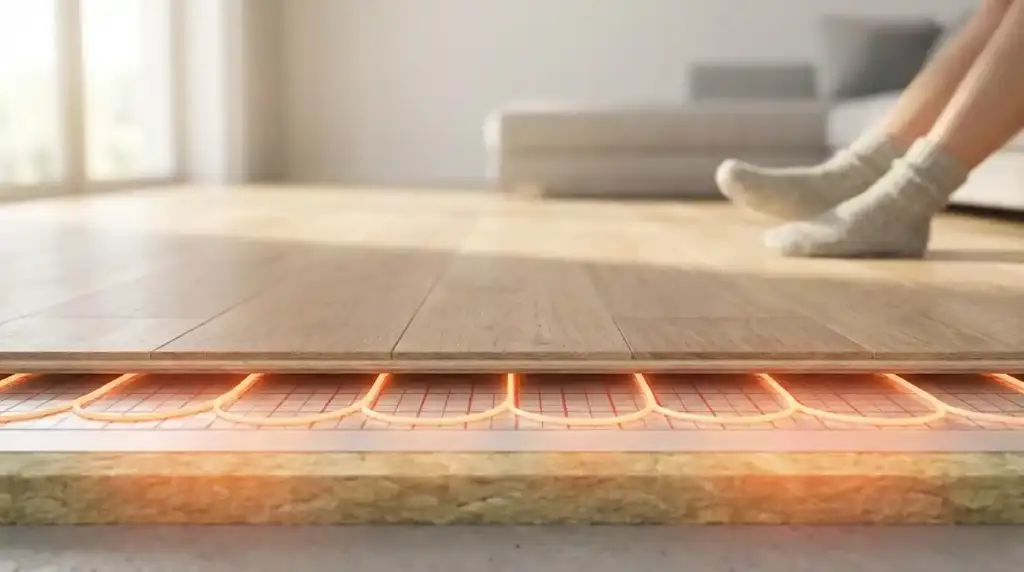
Flooring energy efficiency is a real but often overlooked part of how a building performs. Most attention goes to walls, windows and HVAC equipment, yet the floor is the largest continuous surface in most rooms. Its material affects how heat moves, how well an underfloor heating system works and how much light a room reflects. This guide looks at what the physics actually supports, where marketing claims outrun the evidence, and how to choose flooring for homes, offices and hotels with energy and comfort in mind.
The Science Behind Flooring and Thermal Performance
Thermal conductivity and insulation value
Every flooring material has a thermal conductivity value (λ, in W/m·K) that describes how readily heat passes through it. A lower value means the material insulates. A higher value means heat passes through more easily, which is what you want directly above an underfloor heating system.
Published research on wood-based flooring shows thermal conductivity rising with density, from around 0.09 W/(m·K) for low-density solid wood up to roughly 0.24 W/(m·K) for denser engineered panels, as documented in flooring thermal conductivity testing based on EN 14342. Across flooring categories, dense stone and ceramic transfer heat fastest, wood-based materials insulate more because of their cellular structure, and composites such as SPC sit in between. The exact figure depends on the specific product, so generic ranges are not a substitute for a product’s own test data.
Thermal resistance in practice
For underfloor heating, designers often look at thermal resistance (R, in m²K/W), which combines conductivity and thickness. A common guideline in radiant heating design is to keep the total resistance of flooring plus underlay low, often quoted at around 0.15 m²K/W or less, so the system can deliver heat efficiently. Always follow the heating system maker’s limits.
What our own SPC tests at
Our SPC flooring has been independently tested at a thermal conductivity of 0.122 W/(m·K), with a thermal resistance of 0.048 m²K/W. That is lower in resistance than many floating floor assemblies once underlay is added, and leaves headroom for an underlay within typical radiant heating limits. Ask us for the full test report if you want to verify it.
Why ceramic tile still wins directly over radiant heat
For radiant floor heating, ceramic tile remains the technical benchmark. Its high conductivity lets it absorb and release heat readily. The same insulating property that makes wood comfortable underfoot slightly works against radiant efficiency when the floor itself is the heat source. SPC and engineered wood are both workable over underfloor heating when the product is rated for it. The choice is a trade-off between maximum heat transfer and comfort, look and moisture performance.
Material Comparison for Energy and Comfort
| Material | Heat transfer over radiant heat | Warmth underfoot | Notes |
|---|---|---|---|
| Ceramic and stone tile | Excellent | Cold without heating | Benchmark for radiant systems |
| SPC | Good | Neutral | Check maximum surface temperature rating |
| ResinCore | Good | Neutral | Ask for heated-floor guidance per product |
| Engineered wood | Fair to good | Warm | Stable core suits heating better than solid wood |
| Engineered teak | Fair to good | Warm | Teak’s stability helps with temperature changes |
| Laminate | Fair to good | Neutral | Use an underlay approved for heating |
| Solid hardwood | Fair | Warm | Higher risk of gaps from drying, use with caution |
Teak and Engineered Wood with Underfloor Heating
Real wood can be installed over underfloor heating when the construction and installation are right. Engineered wood is the preferred choice because its cross-layered core limits shrinkage as heating dries the room. Teak is naturally stable and oily, which helps it cope with temperature changes, and engineered teak flooring combines that with a stable core. Keep the surface temperature within the maker’s limit, raise and lower heating gradually at the start of each season, and maintain indoor humidity to avoid gaps.
Energy Considerations by Climate
Cold climates: retention over reflection
In colder regions, the priority is keeping warmth inside. Lower-conductivity floors such as engineered wood, or rigid core floors with an insulating underlay where no floor heating is used, reduce heat loss to cold subfloors. With underfloor heating, radiant systems warm people and surfaces directly, which generally lets occupants feel comfortable at slightly lower air temperatures than with forced air alone.
Warm climates: surface reflectance and humidity
In hot climates the relevant lever is reflectance rather than insulation. Lighter floors absorb less radiant heat in direct sun and feel cooler underfoot. The effect on whole-room cooling load is smaller than roof and wall choices, but it improves comfort near large windows. Humidity control matters more for flooring performance in these regions. See our Florida and Hawaii flooring guide.
How Each Layer Contributes
| Layer | Function |
|---|---|
| Wear layer and finish | Durability, and lighter or glossier finishes reflect more light |
| Decor or wood veneer | Sets color and tone, which affects reflectance and perceived warmth |
| Core | Main driver of conductivity and dimensional stability |
| Underlay | Thermal break and impact sound reduction, see our soundproof flooring guide |
Light Reflectance and Lighting Load
Lighter floors reflect more ambient and artificial light than dark floors. Lighting designers use this to reduce the number of fixtures or wattage needed to reach a target light level. Matte finishes absorb more and feel warmer, glossy finishes reflect more. The savings from floor color alone are modest compared with fixture choice and controls, but it is a free lever when the lighting plan is being finalized. Our guide on how flooring defines interior styles covers the design side.
Installation Checklist for Floors over Underfloor Heating
- Confirm the flooring product is approved for underfloor heating and note its maximum surface temperature.
- Check the combined thermal resistance of flooring and underlay against the heating system’s limit.
- Commission and dry the heating system and screed before flooring goes down.
- Acclimate the flooring in the conditioned room.
- Raise temperature gradually after installation and at the start of each heating season.
- Use rugs sparingly, as thick rugs act as insulation.
Energy, Green Building and Specification
Flooring rarely earns energy credits on its own, but it supports green building goals in other ways. Low-emission products contribute to indoor air quality credits, recycled content supports material credits, and long service life reduces replacement impacts. Read our articles on formaldehyde-free flooring, ESG flooring and flooring lifespan for the wider picture.
What This Means for Material Selection
No single material is universally the energy-efficient choice. Where radiant heating efficiency is the top priority, tile is the benchmark. Where comfort underfoot, moisture resistance and heating compatibility all matter, SPC is a strong middle ground. Where natural warmth and premium look matter most, engineered wood and engineered teak are good choices with the right installation. High density laminate such as MoistureShield 1000 fits value-driven projects.
Frequently Asked Questions
Can flooring choice really affect energy bills?
Yes, but the effect is secondary to insulation, windows and HVAC efficiency. Flooring matters most in how well it works with underfloor heating.
What is the best flooring for underfloor heating?
Ceramic tile transfers heat best. SPC and engineered wood are good alternatives when rated for heated floors. Always check the maximum surface temperature.
Can teak flooring go over underfloor heating?
Engineered teak can, when the product is approved for heating and installed to the maker’s instructions. Solid teak is riskier.
Are darker floors less efficient?
They absorb more light and heat in direct sun and reflect less light into the room. The effect is real but smaller than glazing and roof design.
How does underlay affect thermal performance?
Underlay adds a thermal break, which reduces heat loss downward on unheated floors but adds resistance over underfloor heating. Choose an underlay approved for heated floors.
Does energy-efficient flooring cost more?
Not necessarily. The bigger cost risk is choosing a floor that is not compatible with an existing heating system.
The Bottom Line
Flooring energy efficiency is real but specific. Conductivity and resistance decide how a floor works over underfloor heating, color has a modest effect on lighting, and insulating materials trade some heating efficiency for comfort underfoot. If you are specifying flooring for a project with underfloor heating or thermal requirements, ask us for test data and installation guidance for the series you are considering.