

Buyers, designers and homeowners ask me the same ten questions again and again, usually within the first five minutes of a project conversation. This page collects those flooring FAQs and answers them the way I would across a table: what each material can do, where it stops being the right choice, and what to check before you order.
Where a number matters, I point to a published source instead of quoting a figure from memory. Where the answer depends on the product, I say so, because one material name often covers very different constructions. If you take away one idea about how to choose flooring, make it this: no floor is best at everything, and in my view most disappointments come from putting a good floor in the wrong room.
1. Which Flooring Lasts the Longest?
There is no honest single number, because lifespan depends on what wears the floor out, and each material wears out differently. Solid wood, such as our teak flooring, is the one construction in our range that can be sanded and refinished several times, which is why it can outlast almost anything else when it is looked after. Engineered wood can be refinished too, but only as often as its top veneer allows. SPC and laminate cannot be refinished, so their life ends when the surface wears through or the click joints and edges are damaged.
That is why I ask about traffic, moisture control and the subfloor before I talk about years. For year ranges by material, read our flooring lifespan comparison, and for the wear side of the question, our wear-resistant flooring guide.
| Floor type | What usually ends its life | Can it be refinished? |
|---|---|---|
| Solid teak | Damage too deep to sand out | Yes, more than once |
| Engineered wood | The top veneer is used up | Limited, depends on veneer thickness |
| SPC | Surface wear-through, or damaged click edges and joints | No |
| Laminate | Surface abrasion, or swelling if water reaches the HDF core | No |
2. What Is the Most Waterproof Flooring?
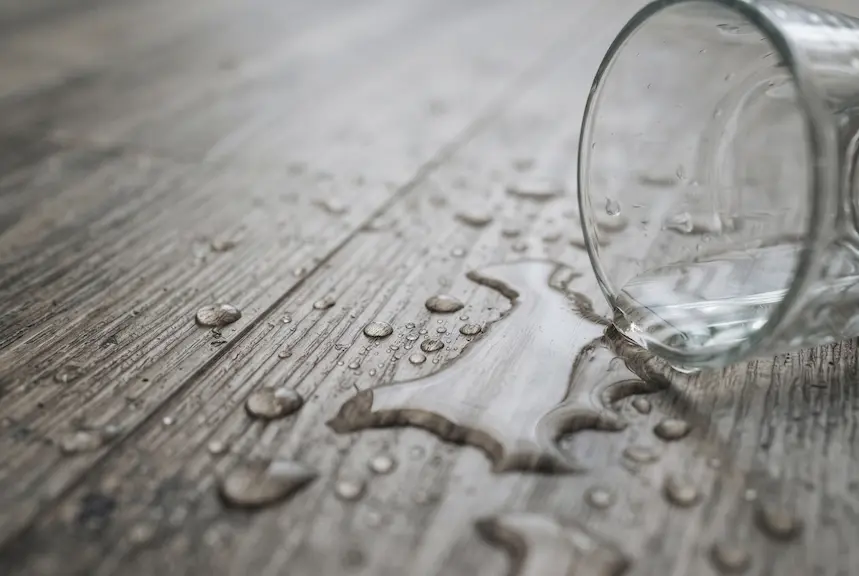
SPC (stone plastic composite) has a waterproof core, which makes it my default recommendation for kitchens and the dry areas of bathrooms. It will not swell or delaminate if a pot boils over or a pet knocks over a water bowl.
A waterproof core is not a waterproof floor
SPC is installed as a floating floor, so water that finds the joints or the room perimeter can still sit underneath the boards. For that reason I do not recommend SPC, or any floating floor, for shower floors or areas with standing water. For a true wet zone, ceramic tile is the correct answer. Our waterproof flooring guide and our kitchen and bathroom flooring page show where the line sits, room by room.
Water-resistant is a different promise
Laminate, even our high-density MoistureShield 1000 with its 1000 kg/m³ HDF core, should be described as water-resistant and never as waterproof. The higher density improves moisture resistance and dimensional stability compared with standard laminate, which is why it suits kitchens and basements better, but standing water is still its enemy. Its advantage over SPC is comfort: it feels softer underfoot, which matters in rooms where people stand or walk barefoot for long periods, and it is a useful alternative for buyers who prefer not to use a plastic-based floor. Wood is a natural material. Teak’s natural oils give it good moisture and pest resistance, and it is among the more dimensionally stable species, but it is still wood and should be kept away from standing water.
3. Which Flooring Is Best for Homes with Pets and Kids?
SPC and laminate are my usual starting points for homes with pets and children. Both are hard-surface floors that wipe clean easily and resist everyday scratching from toys and claws. “Resist” is the important word: neither is scratch-proof, and the construction of the wear layer matters more than the material name.
For SPC, ask which wear layer thickness is offered. Options such as 0.3 mm and 0.5 mm are common, and the thicker one gives more margin in a busy household. For laminate, look at the AC rating, which comes from the European standard EN 13329 and describes resistance to surface abrasion. As a white paper summarized by ANSI explains, wear resistance is a separate property from impact and stain resistance, so an AC rating alone does not tell you how a floor copes with a dropped pan or a spilled dye.
If slip resistance matters, ask for a slip-resistance test report and check which test method it used, rather than relying on a general claim. Rugs in play areas add comfort and grip. Our pet friendly flooring guide goes deeper on claws, accidents and cleaning.
4. How Do I Choose the Right Flooring for My Lifestyle?
I work through three filters in order: what the room does, how the floor should look, and how much upkeep you will realistically accept. The first filter usually removes the most options, so start there.
| Situation | Start with | Why | Watch out for |
|---|---|---|---|
| Kitchen with regular spills | SPC | Waterproof core, quick to install | Not for standing-water areas, hard underfoot |
| Warm wood look with underfloor heating | Engineered wood | Multi-layer core gives dimensional stability and suits underfloor heating | Limited refinishing, confirm veneer thickness |
| Tight budget, dry rooms | Laminate | Cost-effective, scratch-resistant, easy to install | Cannot be refinished, not waterproof |
| Humid climate or basement | SPC or MoistureShield 1000 | Stable in variable humidity, MoistureShield 1000 feels softer underfoot than SPC | MoistureShield 1000 is water-resistant, not waterproof |
| Luxury home or hotel suite | Our solid teak | Premium look, long lifespan, moisture and pest resistance | High purchase cost and higher installation and maintenance cost |
If you are weighing the two click-lock options against each other, our SPC vs laminate flooring comparison goes through the trade-offs in detail, and our humid climate flooring guide covers the damp-environment case.
5. Is Engineered Wood Better Than Solid Wood?
Neither is better in every situation. They solve different problems, and the right choice depends on what you value most. Our solid wood vs engineered wood article covers the full comparison. Here is the short version.
Where engineered wood has the advantage
Engineered wood combines a real wood top layer with a multi-layer core. That structure resists warping better than a single solid plank, suits underfloor heating, and costs less than solid wood. The trade-off is refinishing. How many times you can sand an engineered floor depends almost entirely on the thickness of the top veneer. For reference, the NWFA refinishable program for engineered wood sets a minimum wear layer (the veneer, in the terms used here) of 2.5 mm for factory-finished products. Ask any supplier for the veneer thickness in millimetres.
Where solid wood has the advantage
Solid wood offers natural grain throughout the board and the possibility of multiple refinishes over a long life. Our teak comes in two sourcing options: Burmese teak, and EUDR-compliant teak for buyers who supply the EU market. Its natural oils help it resist moisture and pests. The costs are real, though: a higher purchase price, higher installation and maintenance costs, and a need to let the boards acclimatize to the room before installation.
6. Can I Install Flooring Myself?
Click-lock SPC and laminate are the most DIY-friendly floors we supply, because they float without nails or glue. “Easy” still assumes a prepared subfloor, and in my view subfloor preparation matters more than any other step.
What a floating floor asks of the subfloor
One published installation guide asks for a subfloor level to within roughly 3/16 inch over a 10-foot span (about 5 mm over 3 m), an expansion gap at the walls of around 5/16 inch (about 8 mm), and, over concrete, a vapor barrier such as a 6-mil polyethylene sheet. Your product manual’s tolerances take priority over any general guide. These requirements apply to every floating system, whether SPC, laminate or floating engineered wood.
Which floors to leave to a professional
Solid wood that is nailed or glued, glued engineered wood, and any job with an uneven or damp subfloor are better left to an installer. Most engineered wood is installed floating or nailed, and a few products are glued down, so follow the manufacturer’s method.
| Installation method | Who it suits | Subfloor demands | Notes |
|---|---|---|---|
| Click-lock floating (SPC, laminate) | Careful DIYer | Flat, clean and dry, barrier over concrete | Leave an expansion gap at walls, underlay as specified |
| Floating, nailed or glued engineered wood | Experienced DIYer or installer | Flat, moisture checked first | Follow the manufacturer’s method |
| Solid wood (glued or nailed) | Professional installer | Stable, dry subfloor and controlled humidity | Higher installation cost |
7. How Do I Clean Flooring Safely?
Use a pH-neutral cleaner and a microfiber mop, and avoid harsh chemicals, acidic cleaners such as vinegar, and steam mops, all of which can damage surface coatings. SPC tolerates a damp mop. Wood floors with a protective finish can be cleaned with a well-wrung damp mop. The point is that water must never sit on the surface for long. Oiled finishes protect differently from lacquered ones, so check the care instructions for yours.
Always check the manufacturer’s care instructions for your specific product, because they define what is safe. Our flooring maintenance guide sets out routines by floor type.
8. What Works Best for Small or Dark Rooms?
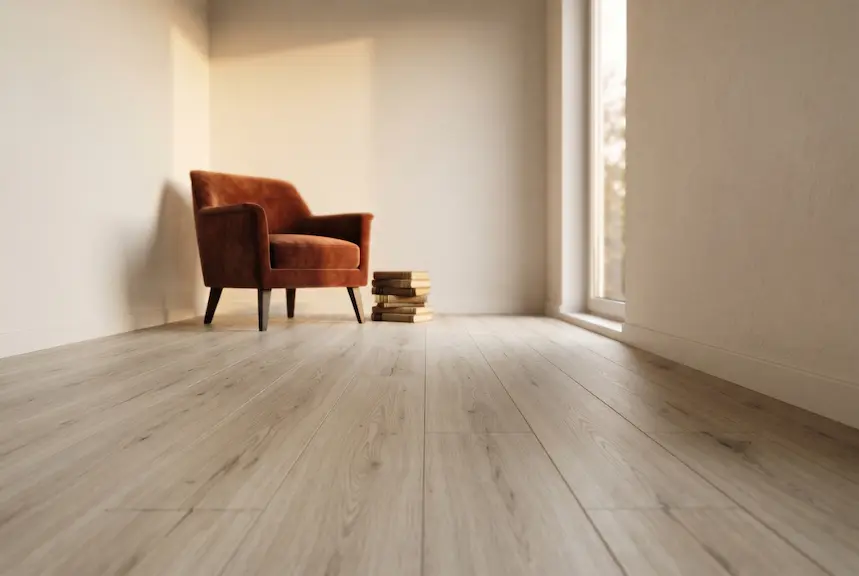
Color does most of the work. Light tones such as white oak or ash looks, available across SPC, laminate and engineered wood, bounce more light around and make a room feel larger. Baseboards close to the floor color give cleaner lines.
Finish is a trade-off rather than a rule. A glossier surface reflects more light, but it also produces glare and shows scratches and dust more readily, while a matte surface is calmer and more forgiving. These are design guidelines, not measured rules. Colors shift under different lighting, so check a sample in the actual room, at different times of day, before you commit. Our interior styles guide has more on tone and pattern.
9. Does Eco-Friendly Flooring Cost More?
It can, but the price gap rarely comes from the label itself. This is the question where wording matters most. The gap comes from what stands behind the label: testing, certification and documentation. “Eco-friendly” is also used for three quite different things, so it helps to separate them.
The first is indoor air quality. FloorScore is a seal showing that a hard-surface flooring product’s VOC emissions meet California’s Section 01350 criteria, verified by an independent certifier with annual retesting. The second is wood sourcing. FSC chain of custody certification tracks forest-based material from the forest through production to the finished product. It speaks to sourcing, not to the whole environmental profile of the floor. The third is recycled content, where innovative products such as our ResinCore recycled resin flooring are still building market awareness.
Regulation matters as well, but it applies differently by material. According to an eco-INSTITUT summary, wood-based products and furniture exceeding the formaldehyde limits in Regulation (EU) 2023/1464 may not be placed on the EU market after 6 August 2026, with a limit of 0.062 mg/m³ cited. That matters for wood-based flooring such as engineered wood, so ask your supplier how the specific product is classified. SPC is not a wood-based material, so the relevant check there is VOC emission testing, which is what FloorScore covers. Our SPC range carries CE and FloorScore certification, and I would rather you request the certificate for the exact product you are buying than rely on any general claim, ours included. Our formaldehyde-free flooring guide explains emission classes in more detail, and our flooring certifications guide explains what each mark proves.
10. How Do I Fix Scratches or Damaged Flooring?
Light scratches on most hard surfaces can be disguised with color-matched wax sticks or repair markers. Deeper damage depends on the floor type.
With a floating click-lock floor such as SPC or laminate, replacing one plank usually means lifting the boards back to the damaged one or cutting it out, so it is easier than re-laying a floor but not instant. Keep a spare box from your original installation, because boards from different production batches can differ slightly in color and gloss.
Engineered wood can be sanded and recoated only if the wear layer is thick enough. Check the thickness before anyone brings in a sander. Our solid teak can be sanded and refinished more than once, which is one of its main strengths.
At a Glance: Material Comparison
This table pulls the main points from the answers above into one view. It is a starting point for a conversation, not a substitute for the technical data of the specific product you are considering.
| Feature | SPC | Laminate | Engineered wood | Solid teak |
|---|---|---|---|---|
| Water behavior | Waterproof core, floating, so not for shower floors | Water-resistant at most, never waterproof | Not waterproof, avoid standing water | Naturally moisture and pest resistant, and relatively stable, but still wood |
| Refinishing | No | No | Limited by veneer thickness | Yes, repeatedly |
| Underfloor heating | Check the maximum surface temperature in the product manual | Check the maximum surface temperature in the product manual | Suitable, multi-layer core adds stability | Confirm with your supplier, solid wood is more sensitive to heat and dryness |
| Typical placement | Kitchens, dry bathroom areas, retail, commercial | Rentals, offices, commercial | Apartments, offices, homes with underfloor heating | Luxury homes, villas, hotel suites, executive offices |
| Main drawback | Hard underfoot, less eco-friendly than natural materials | Cannot be refinished, hard underfoot | Shorter lifespan than solid wood | High cost, higher installation and maintenance |
Still Have Questions About Choosing Flooring?
If your project raises questions that this page does not cover, see our FAQ page or talk to the Karlyn Floors team. Tell us the room, the climate, the traffic and the market you are buying for, and we will tell you honestly which of our floors fits, and which does not. Contact our team.